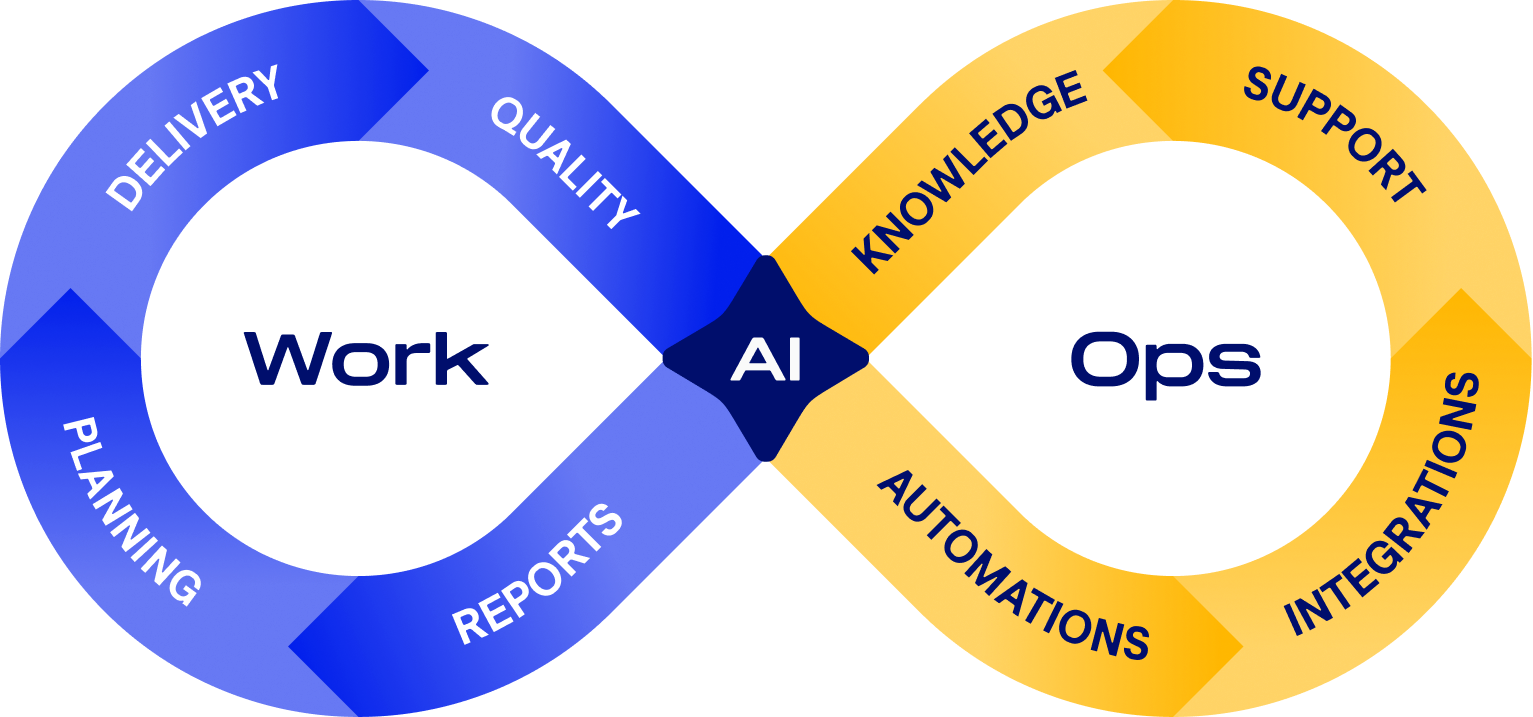
Work and operations, one continuous loop.
WorkOps (Work + Operations) is a framework: a culture and set of practices that integrate work planning, execution, automation, and performance optimisation into a unified, continuously improving system. WorkOps is technology-enabled and people-centric at the same time: AI, automation, and integrations provide the mechanics, while collaboration, transparency, and accountability decide whether they hold.
Decision rules, not values.
Frameworks describe what to do. Principles decide what to do when two right answers collide: planning against delivery, speed against control, one team's convenience against everyone else's visibility. A principle that cannot be violated is not a principle, it is a slogan. The first four govern how work moves. The last four govern what keeps it moving.
-
1
Delivery at the Core
Planning, automation, and support all exist to serve delivery, because value is created only when work actually ships.
-
2
No Gaps Between Teams
Work flows across teams, tools, and functions without waiting in unowned queues, because every handover is designed, owned, and measured.
-
3
Automate by Default
Repetitive work is handled by automation and AI agents, from simple workflows to autonomous processes, so people spend their time on judgment and exceptions.
-
4
Optimise Continuously
Performance is measured constantly, and insights feed continuous refinement, short review cycles, and larger changes when a step change is needed.
-
5
Knowledge Is Infrastructure
Knowledge is structured, current, and easy to find for people and AI alike, because both perform only as well as the knowledge they can reach.
-
6
Nothing Runs Unowned
Every process, automation, and AI agent has a named owner, a defined data scope, and a traceable record of what it did.
-
7
Transparency by Design
Status, priorities, and progress are visible as a by-product of doing the work, not assembled on request for management.
-
8
Fit, Don't Force
WorkOps adapts to the structure, tools, and culture you already have, enabling gradual improvement without disruptive reorganisation.
Not better project management. A different model.
WorkOps treats the organisation as one interconnected network of work, not a collection of separate projects. Four shifts define the difference:
Continuous
Work doesn't end at a project close. Value flows in cycles: the loop, not the Gantt end-date.
Interconnected
Teams, tools and processes form one network. Handoffs are designed connections, not gaps.
Adaptive
Plans adjust to real signals from delivery and operations instead of defending a baseline.
Intelligent
AI agents handle the repetitive layer; people keep judgement, direction and accountability.
What DevOps did for software, WorkOps does for work.
DevOps closed the loop between building software and running it: one continuous cycle of delivery and feedback. WorkOps applies the same logic to the whole organisation. The Work side plans, delivers, checks and reports; the Ops side captures knowledge, supports, automates and integrates; each side feeds the other, continuously.
The term was introduced as an early concept by analyst Chris Marsh at 451 Research (now part of S&P Global Market Intelligence) in 2018. Its current development into the eight-phase, AI-centred loop above is led by Filip Moravek with the team at Easy8, the sponsor of this site.
Sources: WorkOps explained · WorkOps whitepaper (PDF)
See the framework tested in public.
Weekly essays and field guides apply the loop to real disciplines: DevOps, agile, AI at work.
Read the insights